Intro: State the aim of the summit.
List 3 positive points that have come out of the summit.
List 3 negative points that have come out of the summit.
Write a short conclusion stating whether you feel it was successfull or not.
Answer: The main aim of the summit was to discuss ways to achieve the goal of having at leasy 50% of worlds population having access to electronic media by the year 2015.
A positive point that came from the meetin was the fact that alot of countries turned up to the meeting which therefore raises more awareness. They also stated a number of priciples that needed to be met if they had any chance at all of achieving this goal. Also, different countries found out the importance of the internet in economic senses.
Negatives to this meeting was the fact that some people didn't take to the idea to well because they believed that words won't change this situation, only money will which can buy resources to actually make an impact.
To conclude, I feel the summit was some-what successfull in the sense that it raised awareness of the importance of the internet. They all set a very hard goal to meet which could give these nations motivation to do something. However, it is true that words will not change things, only money and resources because you can change anything without these things.
Showing posts with label The Digital Divide. Show all posts
Showing posts with label The Digital Divide. Show all posts

Tackling the Divide on the Ground
|
Wednesday, 29 October 2008
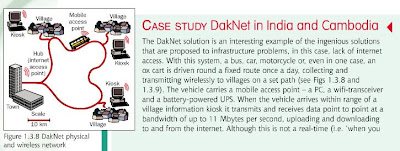
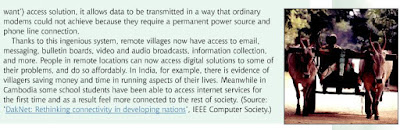
Case Study - Daknet in India and Cambodia
Intro:
Intro:


Discussion - The Success of Wireless Technology
Intro: Why is wireless technology sucessfull solution to the digital divide? Which of the that causes the divide does it overcome? Does the growth in avaliable wireless technology have a clear social, economic, educational and cultural benefits for the society involved?
Answer: Wireless technology is a sucessfull solution to the digital divde because it provides an easy way of providing internet access in remote areas. This is because a car, bus or even an ox cart in remote places can be drove around so the local area can recieve wireless internet. This allows even the more remote places in places such as India and Cambodia, internet access thus reducing the digital divide.
The causes of the divide that wireless technology overcomes is the fact that no infrastructure is needed to set up and use this wireless technology because it is more portable. There is no main building that has to be built, and there no wires needed making wireless technology more easier to use.
The growth in social aspects by using wireless technology is the fact that people could set up online messaging accounts meaning they can communicate easier. Also, they could sign up to a social networking website to communicate easier again. The economic growth from wireless technology is the fact that buisnesses can use the wireless technology to enhance transactions over the internet, or use the internet for research and work. An educational benefit is the fact that the internet is full of educational websites meaning people could access these and be educated online more easier than before. A cultural benefit of this system is the fact that whole communities are using the internet together making the use of the wireless technology more cultural than just the more well off members of society having access.
Case Study - Laos
Tasks: What is the extent of the digital divide in Laos? What problems have causes the divide? What is the impact of the divide on Laos? What solutions have been provided so far? What do you think the educational, social, economic and cultural impacts of these solutions are?
Answer: The digital divide in Laos if fairly large due to many different factors. The fact that there are only 15.000 computers in Laos could add to the divide because the less amount of internet access, the bigger growth in the digital divide. Also, only 1% has a fixed telephone line, yet only 4% of the population have it in households. This is because of the ammounting cost of installing a telephone line ($40). Also, electricity is only avaliable in a few urban areas.
There are many problems which have caused the divide; mountainous geography, monsoon rains, lack of coordination amoung government agencies, lack of IT standards to allow integration between systems, lack of IT at policy and skill levels, poor power and telecommunications infrastructure, poor ISP service, high costs of IT and the lack of Laotian language support.
The impact of the divide on Laos is resulting in there being less than 15,000 computers in Laos because the average cost of a computer is too high for an average Laotian resulting in a bridge in the digital divide.
Soloutions that have been provided so far are as follows; "Cantennae" is a mobile antennae which is made from a can, factory manufactured versions of this are aviable in the U.K. They have also been very successfull as phone based stations. "Pedal Powered wireless computers in Phon Kham. Phon Kham is one of the most poorest areas of Laos. There is no electricity or telephone system, but they have internet access from pedal power. A generator which is powered by a bike charges the battery for a 12 watt computer. It will also work in the monsoon season and the dry season. "The Jhai Foundation PC and communication and internet learning centers". This company has funded a number of community ICT projects. This has resulted in self sustained hubs for community learning. They also teach adults aswell as children.
The educational impacts of the solution 1 is the fact that this kind of technology can be used in schools because it is easy to make and set up. The education impact of solution 2 is the fact that this remote village will be able to be more educated because of the pedal power internet access, so even this remote village can view educational websites. The educational impact of solution 3 is the fact that the internet learning center has become a main hub meaning an anhanced chance for learning. The social impacts of the solutions is the fact that more people can use the different types on internet access, for example the people in Phon Kham can easily access the internet due to this new technology. The cultural impacts of the solutions is the fact that ther culture they are in now with no internet access will be changed. This may not nessasserily be for the better because the internet will be new to them and they may not have the skills to use the internet properly and effectivly. The economic impacts of the solutions is the fact that the countries GNP may increase due to more and easier internet access thus making transactions between countries easier.
Email in the Solomons
Intro: Study the news report on the creation of an internet link for the Solomon islands on the BBC website alongside the world bank data on the islands. Try to identify the extent of the digital divide, the problems that caused the divide, the impact of the divide and the solutions provided so far. Propose at least one furthur initative that would be useful to the islanders in reducing the digital divide.
Answer: The extent of the divide on the solomons is that they are fairly advanced as they have developed a number of different ways of communicating between a number of different islands. The main problems which caused the divide was the fact that tribes who were fighting couldn't communicate with each other by any other means accept word of mouth. However, the solomons came up with a radio-like idea, in which a small laptop with a radio and car battery, powered by the sun via solar panels, which was connected up to communicate between the different islands in the solomons. Another initative that would be useful to the islanders in reducing the divide is to envolve a second hand pc company such as www.donateapc.org.uk where people donate old computers, which are still working, to charities which then distribute the computers to remote areas for use.
How great is the divide and is this changing?
|
Tuesday, 28 October 2008
Investigate Changes in Access
Intro: The ITU has created an index to measure and monitor access to digital technologies over time. Pick two countries from its list of countries and create a short presentation on how these countries access to digital technologies has changed over time.
Answer: Presentation created seperatly
Intro: The ITU has created an index to measure and monitor access to digital technologies over time. Pick two countries from its list of countries and create a short presentation on how these countries access to digital technologies has changed over time.
Answer: Presentation created seperatly
Economic and Social Impacts of the Divide
|
Friday, 24 October 2008
Discussion - Reducing the Divide
Intro:
What advantages are there for the developed world in bridging the global digital divide?
What advantages are there for the poorest nations?
Was President Clinton correct in saying that matching internet access levels with telephone levels will do as much as anything to reduce income equality?
Do charities such as Computer Aid do more good than harm?
Answer:
Advantages for the developed world in bridging the global digital divide is the fact that more people in the world will be more skilled in I.C.T. meaning easier ways of communication. Also, people who immigrate from poorer countries to countries in the developed world will be skilled in I.C.T meaning no extra costs for training. Also, it means that developed countries can set up buisnesses in poorer countries because they are more skilled.
Advantages for the poorest nations is the fact that they have a chance of improving their quality of living because they are more skilled in I.C.T. Also it will be easier to communicate ,through e-mail for example, with other countries. Also, it means that poorer countries will be able to keep up with the economic demands that they are facing which are I.C.T. based.
Matching internet access with telephone levels could reduce income equality because
Personally, i feel computer aid does do more harm than good because if they are suppling the best computers to poorer countries, though this will be good, it will take more time and money to train the people how to use the computers. What they should do is provide technology that is fairly modern, and is either easy to use or people know how to use it.
Intro:
What advantages are there for the developed world in bridging the global digital divide?
What advantages are there for the poorest nations?
Was President Clinton correct in saying that matching internet access levels with telephone levels will do as much as anything to reduce income equality?
Do charities such as Computer Aid do more good than harm?
Answer:
Advantages for the developed world in bridging the global digital divide is the fact that more people in the world will be more skilled in I.C.T. meaning easier ways of communication. Also, people who immigrate from poorer countries to countries in the developed world will be skilled in I.C.T meaning no extra costs for training. Also, it means that developed countries can set up buisnesses in poorer countries because they are more skilled.
Advantages for the poorest nations is the fact that they have a chance of improving their quality of living because they are more skilled in I.C.T. Also it will be easier to communicate ,through e-mail for example, with other countries. Also, it means that poorer countries will be able to keep up with the economic demands that they are facing which are I.C.T. based.
Matching internet access with telephone levels could reduce income equality because
Personally, i feel computer aid does do more harm than good because if they are suppling the best computers to poorer countries, though this will be good, it will take more time and money to train the people how to use the computers. What they should do is provide technology that is fairly modern, and is either easy to use or people know how to use it.
Sources on the Digital Divide
|
Investigate the Impact of access to telecomes
Intro: Using the CIA world factbook as your main source, compare the telecoms sectors of the Central African Republic, Costa Rica, Singapore, the UK and one other under-served country of your choice. Create a table for your findings with the headings; Population, Telephone - Land Lines, Mobile/Cellular, Telephone system, Radio Broadcast stations, country code, internet hosts, internet users.
Central African Republic
Population :- 4,444,330
Telephone-Land Lines in use :- 12,000 (2006)
Mobile/Cellular in use :- 130,000 (2007)
Telephone system :- "limited telephone service; fixed-line connections for well less than 1 per 100 persons coupled with mobile-cellular usage of only about 3 per 100 persons; most fixed-line and cellular telephone services are concentrated in Bangui.
Radio Broadcast Stations :- AM 1, FM 5, shortwave 1 (2001)
Country Code :- .cf
Internet Hosts :- 15 (2007)
Internet Users :- 13,000 (2006)
Costa Rica
Population :- 4,195,914 (July 2008 est.)
Telephone-Land Lines in use :- 1.437 million (2007)
Mobile/Cellular in use :- 1.503 million (2007)
Telephone system :- good domestic telephone service in terms of breadth of coverage; restricted cellular telephone service; state-run monopoly provider is struggling with the demand for new lines, resulting in long waiting times
domestic: point-to-point and point-to-multi-point microwave, fiber-optic, and coaxial cable link rural areas; Internet service is available
Radio Broadcast Stations :- AM 65, FM 51, shortwave 19 (2002)
Country Code :- .cr
Internet Hosts :- 13,792 (2007)
Internet Users :- 1.5 million (2007)
Singapore
Population :- 4,608,167 (July 2008 est.)
Telephone-Land Lines in use :- 1.859 million (2007)
Mobile/Cellular in use :- 5.619 million (2007)
Telephone system :- excellent domestic facilities; launched 3G wireless service in February 2005; combined fixed-line and mobile-cellular teledensity is about 150 telephones per 100 persons
Radio Broadcast Stations :- AM 0, FM 17, shortwave 2 (2003)
Country Code :- .sg
Internet Hosts :- 954,475 (2007)
Internet Users :- 3.105 million (2007)
United Kingdom
Population :- 60,943,912 (July 2008 est.)
Telephone-Land Lines in use :- 33.682 million (2007)
Mobile/Cellular in use :- 71.992 million (2007)
Telephone system :- technologically advanced domestic and international system, equal mix of buried cables, microwave radio relay, and fiber-optic systems.
Radio Broadcast Stations :- AM 219, FM 431, shortwave 3 (1998)
Country Code :- .uk
Internet Hosts :- 5.118 million (2007)
Internet Users :- 40.2 million (2007)
San Marino
Population :- 29,973 (July 2008 est.)
Telephone-Land Lines in use :- 21,000 (2006)
Mobile/Cellular in use :- 17,390 (2006)
Telephone system :- adequate connections, automatic telephone system completely integrated into Italian system
Radio Broadcast Stations :- AM 0, FM 3, shortwave 0 (1998)
Country Code :- .sm
Internet Hosts :- 3,344 (2007)
Internet Users :- 15,400 (2006)
All Facts and Figures taken from CIA - The World Factbook
URL: https://www.cia.gov/library/publications/the-world-factbook/
Intro: Using the CIA world factbook as your main source, compare the telecoms sectors of the Central African Republic, Costa Rica, Singapore, the UK and one other under-served country of your choice. Create a table for your findings with the headings; Population, Telephone - Land Lines, Mobile/Cellular, Telephone system, Radio Broadcast stations, country code, internet hosts, internet users.
Central African Republic
Population :- 4,444,330
Telephone-Land Lines in use :- 12,000 (2006)
Mobile/Cellular in use :- 130,000 (2007)
Telephone system :- "limited telephone service; fixed-line connections for well less than 1 per 100 persons coupled with mobile-cellular usage of only about 3 per 100 persons; most fixed-line and cellular telephone services are concentrated in Bangui.
Radio Broadcast Stations :- AM 1, FM 5, shortwave 1 (2001)
Country Code :- .cf
Internet Hosts :- 15 (2007)
Internet Users :- 13,000 (2006)
Costa Rica
Population :- 4,195,914 (July 2008 est.)
Telephone-Land Lines in use :- 1.437 million (2007)
Mobile/Cellular in use :- 1.503 million (2007)
Telephone system :- good domestic telephone service in terms of breadth of coverage; restricted cellular telephone service; state-run monopoly provider is struggling with the demand for new lines, resulting in long waiting times
domestic: point-to-point and point-to-multi-point microwave, fiber-optic, and coaxial cable link rural areas; Internet service is available
Radio Broadcast Stations :- AM 65, FM 51, shortwave 19 (2002)
Country Code :- .cr
Internet Hosts :- 13,792 (2007)
Internet Users :- 1.5 million (2007)
Singapore
Population :- 4,608,167 (July 2008 est.)
Telephone-Land Lines in use :- 1.859 million (2007)
Mobile/Cellular in use :- 5.619 million (2007)
Telephone system :- excellent domestic facilities; launched 3G wireless service in February 2005; combined fixed-line and mobile-cellular teledensity is about 150 telephones per 100 persons
Radio Broadcast Stations :- AM 0, FM 17, shortwave 2 (2003)
Country Code :- .sg
Internet Hosts :- 954,475 (2007)
Internet Users :- 3.105 million (2007)
United Kingdom
Population :- 60,943,912 (July 2008 est.)
Telephone-Land Lines in use :- 33.682 million (2007)
Mobile/Cellular in use :- 71.992 million (2007)
Telephone system :- technologically advanced domestic and international system, equal mix of buried cables, microwave radio relay, and fiber-optic systems.
Radio Broadcast Stations :- AM 219, FM 431, shortwave 3 (1998)
Country Code :- .uk
Internet Hosts :- 5.118 million (2007)
Internet Users :- 40.2 million (2007)
San Marino
Population :- 29,973 (July 2008 est.)
Telephone-Land Lines in use :- 21,000 (2006)
Mobile/Cellular in use :- 17,390 (2006)
Telephone system :- adequate connections, automatic telephone system completely integrated into Italian system
Radio Broadcast Stations :- AM 0, FM 3, shortwave 0 (1998)
Country Code :- .sm
Internet Hosts :- 3,344 (2007)
Internet Users :- 15,400 (2006)
All Facts and Figures taken from CIA - The World Factbook
URL: https://www.cia.gov/library/publications/the-world-factbook/
Introduction and Factors creating the Digital Divide
|
Wednesday, 22 October 2008
What leads to being on the wrong side of the divide?
Intro: The least digitally developed countries according to the ITU are Guinea Biseau, Chad, Mali, Burkino Fasso and Niger. Using an atlas plus information from the ITU, write down some reasons why they might be on the wrong side of the divide.
Answer: These countries may be on the wrong side of the digital divide because of their geographical location. For example, places such as Chad, Mali and Niger have parts were they have parts of the country covered by the sahara desert meaning less population meaning less chance of digital equipment access. Also, Africa is the poorest continent on earth. This means they may not be able to afford the technology to provdide digital equipment thus meaning they are on the wrong side of the divide. Also, according to the ITU "ICT/Telecommunication development in least-developed countries (LDCs) is ramping up,a nd that the digital divide is being bridghed as a result." Taken from the ITU Website
URL: http://www.itu.int/ITU-D/ldc/newslog/Bridging+The+Digital+Divide+.aspx
Data Response
Intro: In the section, Current Status of information technology in Sub-Saharan Africa:
Dr Odedra cites a number of infrastructual reasons for the lack of effective ICT.
What are these?
What is identified as the most pressing need for Africa (in terms of ICT)?
How successful have computer-aid projects been?
Why have they failed?
What computer skills are identified as lacking?
What lack of business skills are identified as a major problem?
Answer: The infrastructual reasons for the lact of effective ICT in less econmically developed countries is the fact that there is a lack of secondary euquipment, suitable electric power, and training. This therefore leads to people not being as experienced in the technology they are using. Also, they depend alot on Multinational Corporations meaning they have to wait for the money then just using the money straight off.
Off-the-shelf software packages has been identified as the most pressing need for ICT in africa because of the growing demand in applications. Also, it is much easier to purchase as you are buying a physcial package rather than downloading the package. Also, if you don't have internet access, this will be very useful. Also, microcomputers and personal computers have become very popular in terms of ICT because of the reduction in price.
Computer-aid projects havn't been so successful. Extensive under-ultilization of equipment and major computer based projects have failed. It hasn't been as successfull in the majority of countries when it should only be the minority.
These projects have failed because of the lack of secondary equipment, suitable electric power and training. Also, the governments of the countries involved havn't set up any strategic buying plans so everything comes in bluk or too little software comes meaning more or less people need training. Also, there is a lack of avaiable resources to maintain the ICT.
Identified computer skills that are lack are; systems analysis, programming, maintainace, consulting, operational levels from basic use to management.
The lack of buisness skills which are identified as a major problem is the fact that buisness' are buying software which no one is trained in. They need to plan which software to buy, and whether their staff are trained in this area of ICT. Also, the employee's have a lack of skills to begin with meaning they can't use the software.
URL: http://www.unu.edu/unupress/unupbooks/uu37we/uu37we0s.htm
Intro: The least digitally developed countries according to the ITU are Guinea Biseau, Chad, Mali, Burkino Fasso and Niger. Using an atlas plus information from the ITU, write down some reasons why they might be on the wrong side of the divide.
Answer: These countries may be on the wrong side of the digital divide because of their geographical location. For example, places such as Chad, Mali and Niger have parts were they have parts of the country covered by the sahara desert meaning less population meaning less chance of digital equipment access. Also, Africa is the poorest continent on earth. This means they may not be able to afford the technology to provdide digital equipment thus meaning they are on the wrong side of the divide. Also, according to the ITU "ICT/Telecommunication development in least-developed countries (LDCs) is ramping up,a nd that the digital divide is being bridghed as a result." Taken from the ITU Website
URL: http://www.itu.int/ITU-D/ldc/newslog/Bridging+The+Digital+Divide+.aspx
Data Response
Intro: In the section, Current Status of information technology in Sub-Saharan Africa:
Dr Odedra cites a number of infrastructual reasons for the lack of effective ICT.
What are these?
What is identified as the most pressing need for Africa (in terms of ICT)?
How successful have computer-aid projects been?
Why have they failed?
What computer skills are identified as lacking?
What lack of business skills are identified as a major problem?
Answer: The infrastructual reasons for the lact of effective ICT in less econmically developed countries is the fact that there is a lack of secondary euquipment, suitable electric power, and training. This therefore leads to people not being as experienced in the technology they are using. Also, they depend alot on Multinational Corporations meaning they have to wait for the money then just using the money straight off.
Off-the-shelf software packages has been identified as the most pressing need for ICT in africa because of the growing demand in applications. Also, it is much easier to purchase as you are buying a physcial package rather than downloading the package. Also, if you don't have internet access, this will be very useful. Also, microcomputers and personal computers have become very popular in terms of ICT because of the reduction in price.
Computer-aid projects havn't been so successful. Extensive under-ultilization of equipment and major computer based projects have failed. It hasn't been as successfull in the majority of countries when it should only be the minority.
These projects have failed because of the lack of secondary equipment, suitable electric power and training. Also, the governments of the countries involved havn't set up any strategic buying plans so everything comes in bluk or too little software comes meaning more or less people need training. Also, there is a lack of avaiable resources to maintain the ICT.
Identified computer skills that are lack are; systems analysis, programming, maintainace, consulting, operational levels from basic use to management.
The lack of buisness skills which are identified as a major problem is the fact that buisness' are buying software which no one is trained in. They need to plan which software to buy, and whether their staff are trained in this area of ICT. Also, the employee's have a lack of skills to begin with meaning they can't use the software.
URL: http://www.unu.edu/unupress/unupbooks/uu37we/uu37we0s.htm
Subscribe to:
Posts (Atom)